Building on practical experience
Loki is actively developed and supported, and runs in dozens of systems and services, from transport lines to source registers.
Your process calls for a solution of its own. Many of the functions underneath are familiar: signing in, recording data, finding changes and producing reports.
We have already built that base. Loki is the Stroetenga software foundation, with reusable building blocks for radiological applications. That lets us focus our development on your way of working, your equipment and your specific questions.
Loki supports applications on the desktop, in the browser and on phone and tablet. Which parts we use depends on your process.
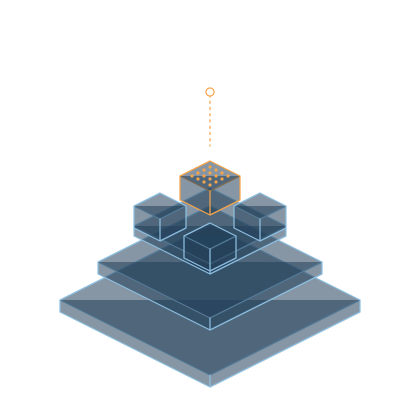
Loki is not one program but a family of libraries for every environment your software runs in.
 Server
Services that process, exchange and monitor data in the background.
 Desktop
Applications for the office and the laboratory.
 Phone and tablet
Recording at the workplace, also on the move.
 Web
Portals and web applications, tailored to users and their work.
 Standalone tools
Apps and tools that work on their own, without a full system around them.
 Data storage
One consistent way to record data and its history.
A source register has to determine the activity of a source on a chosen date. In waste management you want to know when the activity falls below a limit. Different questions, with the same physics underneath.
In Loki these applications share the same building blocks for radioactive decay. We connect them to the records, checks and process steps your work requires. That way we focus our development on your application, while the calculation base is already there.
The approach goes beyond calculations. Data management, reports and interfaces also build on shared facilities. What we learn and improve, we can carry over, under control, to later applications and releases.

These facilities are available within Loki. For each application we decide which functions are needed and how they are used.

One central sign-in for your systems, with your company account where you have one. Accounts, roles and a lock after repeated failed attempts are standard.
Ask about it →

Screens switch language while you work. Dutch and English are the base, extendable with a language of your choice, such as German, French or Spanish. Adding a language is translation work, not development.
Ask about it →

Systems on Loki read detectors, scanners, dosimeter readers and RFID directly, and connect to other software over their own interface.
Ask about it →

Decay, waiting times, distance and dose rate from one shared set of formulas, not retyped in every system.
Ask about it →

Reports for management and regulators, and notification mail from templates that can be adjusted per system.
Ask about it →

Departments or organisations side by side on one installation, each in its own portal.
Ask about it →
Four principles apply to every system we build on Loki.
 History on every record
Every record keeps who created and changed it; earlier versions stay available. That is the base, not an option per project.
 Standardised installation
Every installation is set up the same way, and every release carries a code that says exactly what it contains.
 Quality documents as standard
Every system comes with quality documents as standard, in a fixed structure.
 Testing as a fixed part
Automated screen tests are part of the development process and record their results.
Around Loki sit central services that applications connect to as needed. Some of them are still in development.


Tell us which activities, equipment and systems you want to connect. Then we discuss which existing building blocks fit and what your application needs in addition.